Generative AI
Claude Opus 5.6: a strong demo, but no basis for planning
Claude Opus 5.6 has not been announced, yet a viral presentation is causing a stir. Companies should plan with confirmed models and prices.
By Sascha Sambale · · 8 min read
- Generative AI
- AI strategy
- ROI
- SMEs
 AI-generated
Claude Opus 5.6 is so far a rumor, not a product. Anthropic has not announced the model, and it does not appear in the official model list. It has nevertheless been causing a stir since late November 2026, because users are showing results that are said to come from an unreleased version. For companies, that is no reason to change plans. It is, however, a reason to review their own choice of model.
The best-known example is a presentation titled The Last Boring Slide. The user Nikita (@fluxxrider) published it on November 25 in a post on the platform X. According to a report by the news site BigGo, it consists of 13 scenes that the model produced as program code. By November 27, the post had been viewed around twelve million times. Building it cost the equivalent of 90 US dollars, the author writes in a reply to the post.
What is confirmed about Claude Opus 5.6?
Nothing is confirmed. Anthropic has neither confirmed the existence of Opus 5.6 nor described what is said to have changed, BigGo reports. Anthropic’s model overview names Fable 5.2, Opus 5.5, Sonnet 5.5 and Haiku 5.5 as its current models. A model ID, a price and a date for Opus 5.6 are missing.
What does exist are reports from users. They suspect that Anthropic is running a new version on a share of the requests sent to Opus 5.5. According to BigGo, the industry watcher TestingCatalog flagged this on November 25 as a possible staged rollout. From the outside, however, nobody can check which model produced a given answer.
Benchmark scores, prices and launch dates for Opus 5.6 are also circulating online. None of these figures comes from Anthropic or from an independent evaluator. That is why this article leaves them out.
What is certain is the status quo. Opus 5.5 has been available since September 22, 2026, and according to Anthropic costs 4 US dollars per million input tokens and 20 US dollars per million output tokens.
What does the viral presentation really show?
It shows what a language model can do when it is allowed to compute for a long time. According to the Chinese tech magazine ifanr, the model worked on the presentation for 42 minutes at the “xhigh” effort level, a high setting for the amount of compute. The author specified no visual style and supplied no material, the magazine writes. All visual effects were created as program code.
The prompt consists of five sentences. The author published it in a reply to the post:
“Make a presentation on the future of AI and basically the intelligence explosion. You can go full no anchor bias, like things are going to get crazy because they are. I want this presentation to be the most elaborately, insanely amazing presentation you’ve ever seen, with all sorts of graphics, transitions, whatever you want. I believe you can make it amazing because you have taste and you have the ability. Good luck, Claude.” – Nikita (@fluxxrider), author of the presentation, in a reply to the post on X
The prompt names the topic and the ambition, nothing more. The model chose the structure, the imagery and the transitions itself.
The presentation can be opened in the browser and controlled with the arrow keys. It starts as a plain default slide and then rebuilds itself. The video below shows the first minute.
That effort has its price. The task used two to three percent of the weekly usage quota, the author wrote on X a day later. At the API prices of Opus 5.5, that is equivalent to 90 US dollars. For a single presentation, that is a lot. For the first draft of a product concept that a team would otherwise spend days on, it may be very little.
A word of caution: a single result says little about the typical case. Language models deliver different results for the same input, and people mainly share the successful ones. On top of that, nobody outside Anthropic can prove which model produced the presentation.
How close are the confirmed top models?
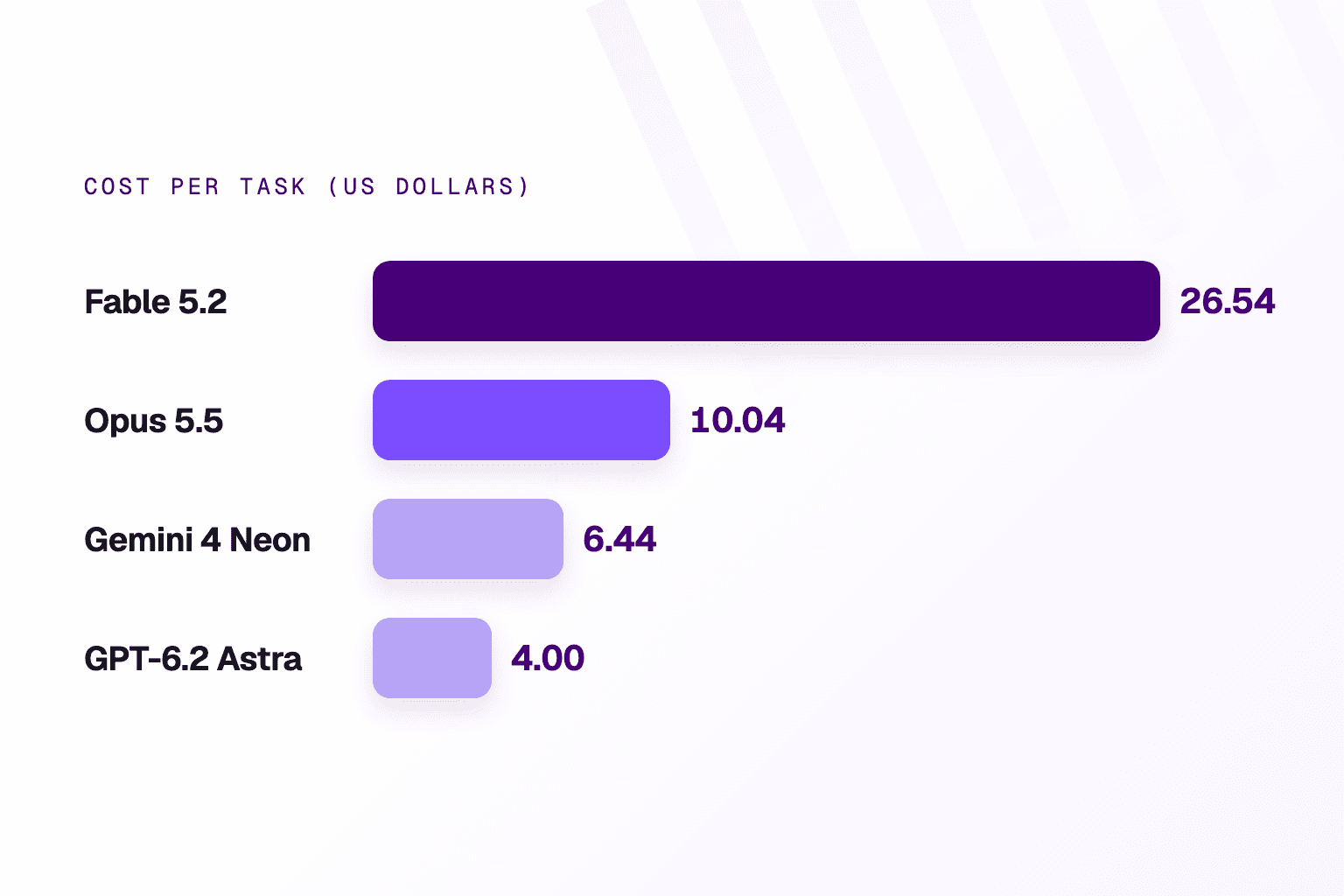
Very close, at least in performance. In the Intelligence Index from the independent evaluation service Artificial Analysis, Claude Fable 5.2 leads with 65 points. OpenAI’s GPT-6.2 Astra and Google’s Gemini 4 Neon follow with 62 points each, and Claude Opus 5.5 reaches 59 points. The cost per task, by contrast, varies by a multiple.
The index combines nine tests into one score. Since version 5, 60 percent of it has been based on tests with private tasks or held-out answers, Artificial Analysis says. That makes it harder to train a model specifically for these tests.
| Model | Provider | Intelligence Index | Cost per task in US dollars | Status |
|---|---|---|---|---|
| Claude Fable 5.2 | Anthropic | 65 | 26.54 | available |
| GPT-6.2 Astra | OpenAI | 62 | 4.00 | available |
| Gemini 4 Neon | 62 | 6.44 | available | |
| Claude Opus 5.5 | Anthropic | 59 | 10.04 | available |
| Claude Opus 5.6 | Anthropic | not measured | not stated | not announced |
The figures come from the Artificial Analysis leaderboard as of November 27, 2026, version 5.0.2 of the index. The models were measured at the “Max” level, Gemini 4 Neon at “xhigh”. The cost per task states what one task in the index costs on average.
 AI-generated
At the highest level, Fable 5.2 costs 6.6 times as much per task as GPT-6.2 Astra and is three points ahead. Whether that lead is worth the extra cost depends on the task.
The effort level drives the bill more than the choice of model does. At the “High” and “xhigh” levels, Fable 5.2 scores 62 points at Artificial Analysis. At low effort, the model matches the best score of Opus 5.5 on the test Humanity’s Last Exam for less than one-tenth of the cost per task, Anthropic says. The table therefore shows the most expensive setting, not typical operation.
A possible Opus 5.6 would enter a crowded field. Even a clear jump would settle the ranking only for a short time.
Why is a rumor no basis for planning?
Because neither price nor availability nor contract terms can be derived from a rumor. To use a model, a company needs a model ID, a price list, information on data processing and a provider that stands behind it. None of that exists for Opus 5.6. Planning is only possible with released models.
The demo still contains a useful insight. Quality depends more and more on how long a model is allowed to compute. The effort level sets how thoroughly a model reasons and how many tokens it uses to do so. Compute time thus becomes a lever that determines both cost and result.
The price per token is therefore not enough for an assessment. The meaningful figure is the cost per successful outcome: the cost of all tokens including failed attempts, plus the working time for review and rework, divided by the number of tasks completed correctly. How much the effort level changes this calculation is shown in the article Claude Fable 5.2: why the top score is not the real news.
What companies should do now
- Plan with released models. Budgets, schedules and commitments to the business units rest on models with a model ID and a price list.
- Keep your own test tasks ready. A few dozen real cases from your own process quickly show whether a new model works better than the current one.
- Measure the cost per successful outcome, including compute time, failed attempts and rework.
- Keep the model swappable. Model name and effort level belong in the configuration, not in the program code.
- Read demos as a hint, not as proof. What matters is whether a result can be repeated with your own tasks.
Which tasks are suitable as test cases can be defined in an AI workshop with the business units. How that becomes an AI strategy for mid-sized companies (Mittelstand) that does not hinge on a single model is described on the page on AI consulting for SMEs.
In short: the next model will come, whether it is called Opus 5.6 or something else. Companies that know their test tasks and metrics do not need to follow rumors. They check on the day of the release whether the switch pays off.
Frequently asked questions
Is Claude Opus 5.6 available yet?
No, not officially. As of November 27, 2026, Anthropic has neither announced nor confirmed Claude Opus 5.6. There is no model ID, no price and no date. Since late November, users have been reporting results that are said to come from an unreleased version. From the outside, nobody can check which model produced those results. The current Opus model is still Opus 5.5.
When will Claude Opus 5.6 be released?
That is not known. Anthropic has not named a date, and the time frames mentioned online cannot be traced to a verifiable source. Companies should therefore not tie projects to an assumed date. It makes more sense to prepare your own test tasks. Then a new model can be compared with the current one on the day of its release, and the decision to switch can be based on facts.
What is The Last Boring Slide?
The Last Boring Slide is an interactive presentation published by the user Nikita (@fluxxrider) on the platform X. It is said to come from an unreleased Claude version, and all of its visual effects consist of program code. According to the magazine ifanr, the model ran for 42 minutes to produce it. By November 27, 2026, the post had been viewed around twelve million times. Anthropic has not confirmed whether a new model is actually behind it.
Which AI model is the best in November 2026?
In the Intelligence Index from Artificial Analysis, Anthropic’s Claude Fable 5.2 leads with 65 points. OpenAI’s GPT-6.2 Astra and Google’s Gemini 4 Neon follow with 62 points each, and Claude Opus 5.5 has 59 points. At the highest effort level, the cost per task ranges from 4.00 US dollars for GPT-6.2 Astra to 26.54 US dollars for Fable 5.2. Which model is best therefore depends on the task and the budget.
Put new AI models into context before they drive your planning
The keynote shows how leadership and IT can assess rumors, benchmarks and demos, and what model decisions in a company can reliably be based on.
Request a keynoteSources
- Introducing Claude Fable 5.2 and Claude Mythos 5.2 – Anthropic, November 9, 2026
- Models overview – Anthropic, Claude Platform Docs
- Introducing Claude Opus 5.5 – Anthropic, September 22, 2026
- Anthropic's Unreleased Claude Model Surfaces in User Tests, Turning Code Into Animation – BigGo Finance, November 27, 2026
- Claude Opus 5.6 做出了史上最牛的 PPT,直接杀死比赛? – ifanr, November 27, 2026
- Opus 5.6 is unceremoniously the most powerful model I've laid my hands on – Nikita (@fluxxrider), X, November 25, 2026
- LLM Leaderboard - Comparison of AI models from OpenAI, Anthropic, Google, Meta & others – Artificial Analysis
- Announcing Artificial Analysis Intelligence Index v5 – Artificial Analysis, October 27, 2026