Generative AI
Claude Fable 5.2: why the top score is not the real news
Claude Fable 5.2 scores 74.2 percent on Humanity’s Last Exam. For companies, something else matters: the same quality at a much lower cost per task.
By Sascha Sambale · · 8 min read
- Generative AI
- AI agents
- ROI
- AI strategy
 AI-generated
Claude Fable 5.2 has been available since November 9, 2026. Anthropic’s new top model scores 74.2 percent on the test Humanity’s Last Exam, the highest value in the company’s comparison. For companies, the more important news sits one line further down. The model delivers the quality of the previous workhorse, Opus 5.5, at a fraction of the cost per task.
Humanity’s Last Exam is considered one of the hardest tests for language models. It contains 2,500 expert-level questions across dozens of subjects, developed by the Center for AI Safety and the company Scale AI. The test was created because leading models had almost fully solved older exams.
At the same time, Anthropic is cutting the price. Fable 5.2 costs 8 US dollars per million input tokens and 40 US dollars per million output tokens. Its predecessor Fable 5.1 was priced at 10 and 50 US dollars. That is a reduction of 20 percent.
What did Fable 5.2 achieve on Humanity’s Last Exam?
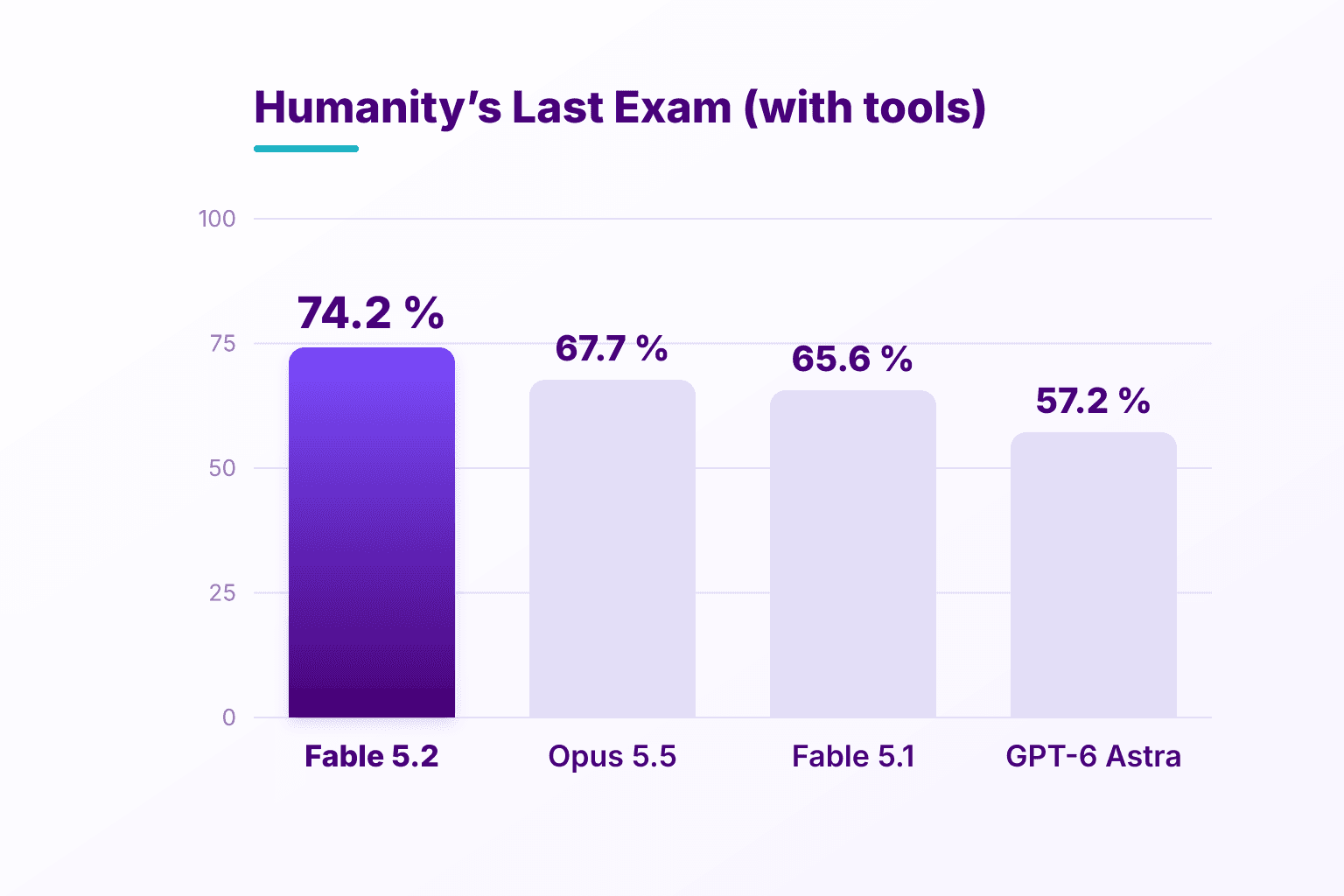
According to Anthropic, Fable 5.2 solves 74.2 percent of the questions when the model is allowed to use tools. Its predecessor Fable 5.1 reached 65.6 percent, Opus 5.5 reached 67.7 percent and OpenAI’s GPT-6 Astra 57.2 percent. The table gives no value for Google’s Gemini 4 Carbon.
 AI-generated
Two caveats belong here. The figures come from the vendor itself and have not been independently confirmed so far. Anthropic also does not speak of a record in its announcement. The company claims the highest score of any model it tested only for the coding test FrontierCode 2.0.
The gap to the predecessor is notable all the same. Almost nine percentage points within one model generation is a large step on a test that was built specifically to resist quick saturation.
Where does Fable 5.2 lead, and where not?
In Anthropic’s comparison, Fable 5.2 leads in software development, computer use and long independent tasks. In automated business workflows, however, Gemini 4 Carbon is slightly ahead. Anyone choosing a model for a specific process should therefore look at the matching test and not at the overall impression.
| Test (figures in percent) | Fable 5.2 | Opus 5.5 | GPT-6 Astra | Gemini 4 Carbon |
|---|---|---|---|---|
| FrontierCode 2.0 (coding with agents) | 49.1 | 45.5 | 42.8 | 41.1 |
| FrontierSWE v2 (coding with agents) | 69.9 | 62.3 | 65.5 | 61.2 |
| AutomationBench (business workflows) | 51.4 | 42.5 | 41.4 | 53.9 |
| OSWorld 2.1 (computer use) | 89.3 | 87.2 | 79.5 | 81.5 |
| Remote Labor Index (freelance-style jobs) | 41.3 | 21.3 | 20.8 | not reported |
| Humanity’s Last Exam (with tools) | 74.2 | 67.7 | 57.2 | not reported |
All values come from Anthropic’s announcement. The gap is widest on the Remote Labor Index, which checks complete jobs: Fable 5.2 finishes almost twice as many there as Opus 5.5. A first independent data point comes from the evaluation service Vals AI. In its Vals Index, Fable 5.2 ranks first of 36 models with 71.31 percent.
How do Google, Meta and Alibaba compare?
Values on Humanity’s Last Exam are also available for the latest models from Google, Meta and Alibaba. They come from different measurements and can therefore only be compared roughly.
| Model | Vendor | Score in percent | Measured by |
|---|---|---|---|
| Claude Fable 5.2 | Anthropic | 74.2 | Anthropic, with tools |
| Claude Opus 5.5 | Anthropic | 61.4 | Artificial Analysis |
| Gemini 4 Carbon | 60.4 | Artificial Analysis | |
| Gemini 4 Argon | 57.1 | Artificial Analysis | |
| Muse Wonder Full | Meta | 53.6 | Meta |
| Qwen3.8 Max | Alibaba | 43.6 | Alibaba |
The independent evaluation service Artificial Analysis tests all models under uniform conditions. Fable 5.2 was not yet listed there at the time of writing. Opus 5.5 shows how much the test conditions shape the result: in Anthropic’s measurement with tools the model reaches 67.7 percent, at Artificial Analysis 61.4 percent.
The lead of Fable 5.2 is therefore likely to be smaller in a uniform measurement than the table suggests. The order is still visible. Google follows closely behind Anthropic with Gemini 4 Carbon, while Meta and Alibaba trail at a distance.
The real news is the cost per task
Fable 5.2 reaches the quality of Opus 5.5 with far less effort. At low effort, the model matches the best score of Opus 5.5 on Humanity’s Last Exam for less than one-tenth of the cost per task, Anthropic says. The effort level sets how thoroughly a model reasons and how many tokens it spends doing so.
The pattern repeats in coding. At the “High” level, Fable 5.2 reaches 45.3 percent on FrontierCode, according to Anthropic. That is practically the best score of Opus 5.5 at 45.5 percent, for roughly half the cost per task. Outputs are also said to be up to 30 percent faster than with the predecessor.
This is notable because Opus 5.5 costs only half as much per token: 4 US dollars per million input tokens and 20 US dollars per million output tokens. The more expensive model is still the cheaper one here, because it gets to the result with fewer steps and fewer tokens. The price per token therefore says little about the bill at the end of the month.
For planning, this adds a new lever. Besides the choice of model, the effort level decides cost and quality, and it can be set per task.
What do the examples of multi-day agent work show?
They show that teams of AI agents can now work on one task for days. An AI agent is a system that pursues a goal, uses tools and carries out several steps on its own. Anthropic describes two cases in which Fable 5.2 coordinated around 1,000 such agents each.
In the first case, a prototype became an operating system that boots on a laptop. The agents worked on it around the clock for eight days. In the second case, a team of agents formalized the proof of Fermat’s Last Theorem in 30 hours. The first formalization had taken eleven days. In the same setup, Opus 5.5 completed only 26 percent in 18 hours, Anthropic reports.
A word of caution: these are vendor demonstrations under ideal conditions, with a clear goal and a result that can be checked. In a company, goals are rarely that clear-cut. The longer agents work on their own, the more important fixed roles, permissions and controls become. The article AI agents need a personnel file describes what that can look like.
What do companies need to know before adoption?
Three points from the announcement affect operations directly: data retention, the safeguards and availability. All three should be settled before the model sees production data.
Data retention. Anthropic stores inputs and outputs of Fable 5.2 for 30 days for safety monitoring. Operation without any retention is only possible for eligible customers. Companies in the EU that process personal data should review this with their data protection officer.
Safeguards. Fable 5.2 blocks risky cybersecurity requests, such as penetration testing and exploit generation. It also blocks most research biology tasks. Such requests are then answered by an older model. Compared with the predecessor, there are around 55 percent fewer blocks, Anthropic says. The variant without these safeguards is called Mythos 5.2 and is only open to vetted organizations.
Availability. The model is available from Anthropic itself and through Amazon Web Services, Google Cloud and Microsoft Azure. Companies with an existing cloud contract do not need a new procurement channel.
What companies should do now
- Put together your own test tasks. A few dozen real cases from your own process say more about the benefit than any leaderboard.
- Measure the cost per successful outcome, not the price per token. That includes failed attempts and the time for review and rework.
- Try out the effort levels. A low level is often enough, and the highest one pays off only for a few hard cases.
- Choose the model per step. Top models belong in planning and exceptions, small models and conventional software in the routine.
- Check data retention and safeguards against your own requirements before production data flows.
Which processes are suitable for a first test can be worked out in an AI workshop with the business units. How this becomes an architecture with the right model for each step, especially for mid-sized companies (Mittelstand), is described on the page on AI consulting for SMEs.
In short: the leaderboard changes with every release, and the next top score is certain to come. What stays is the question of what a completed task costs. Companies that have built their processes so that model and effort level can be swapped benefit from every new model without starting over.
Frequently asked questions
What is Claude Fable 5.2?
Claude Fable 5.2 is Anthropic’s most capable generally available language model, released on November 9, 2026. It is built for demanding work that takes many steps over hours or days, such as software development with agents. Technically it is the same model as Claude Mythos 5.2, but with safeguards for cybersecurity and biology. That allows Anthropic to offer it to all customers, on its own platform and through Amazon Web Services, Google Cloud and Microsoft Azure.
How much does Claude Fable 5.2 cost?
According to Anthropic, Claude Fable 5.2 costs 8 US dollars per million input tokens and 40 US dollars per million output tokens. That is 20 percent less than its predecessor Fable 5.1 at 10 and 50 US dollars. Fast mode, with up to 2.5 times the output speed, costs double: 16 and 80 US dollars. What decides the bill, however, is how many tokens a task consumes in total.
What is Humanity’s Last Exam?
Humanity’s Last Exam is a test for language models with 2,500 expert-level questions across dozens of subjects. It was developed by the Center for AI Safety and the company Scale AI together with subject experts from around the world. The test was created because leading models had almost fully solved older exams, so progress could hardly be measured anymore. It checks specialist knowledge and reasoning, not usefulness in a company’s daily work.
What is the difference between Claude Fable 5.2 and Mythos 5.2?
According to Anthropic, both are the same underlying model. Fable 5.2 has safeguards that block risky cybersecurity requests and most research biology tasks, and in return it is generally available. Mythos 5.2 runs without these safeguards and is only open to vetted organizations that work in these areas, for example in IT security or the life sciences. For most companies, Fable 5.2 is the relevant variant.
What new AI models mean for your company
The keynote puts new models such as Claude Fable 5.2 into context: what benchmarks tell you, where adoption pays off and which decisions leadership and IT now face.
Request a keynoteSources
- Introducing Claude Fable 5.2 and Claude Mythos 5.2 – Anthropic, November 9, 2026
- Pricing – Anthropic, Claude Platform Docs
- Humanity's Last Exam – Center for AI Safety and Scale AI, arXiv, January 24, 2025
- Claude Fable 5.2 Benchmarks, Cost and Capabilities – Vals AI
- Humanity's Last Exam Benchmark Leaderboard – Artificial Analysis
- AA-HLE Leaderboard & Scores – November 2026 – BenchLM (data: Artificial Analysis)
- Meta Muse Wonder: Top Benchmarks Challenge Claude and GPT – IAMAG (data: Meta)
- Qwen3.8-Max: Features, Benchmarks, and Pricing – DataCamp (data: Alibaba)