AI agents
AI agents need a personnel file, not a software license
Most AI projects fail on leadership and processes, not technology. Companies that deploy AI agents need clear roles, firm limits and regular feedback.
By Sascha Sambale · · 9 min read
- AI agents
- AI transformation
- SMEs
- AI governance
- EU AI Act
 AI-generated
Companies that want to deploy AI agents should treat them like new employees, not like another software license. An AI agent is a system that pursues a goal, uses tools and carries out multiple steps on its own. That is why it needs what every new hire gets: a clear role, defined permissions, a manager and regular feedback. The issue is pressing because companies want to give their agents more freedom than their controls can currently handle.
According to the Applied AI Index 2026 by Boston Consulting Group (BCG), 42 percent of companies expect their agents to make decisions without human approval by 2030. Only five percent have the relevant controls in place, BCG says. Companies with all six controls in the study generate three times as much value from agentic AI as companies with just one.
The track record of AI projects so far calls for caution. S&P Global Market Intelligence surveyed more than 1,000 respondents. In 2025, 42 percent of companies abandoned most of their AI initiatives, up from 17 percent the year before.
Why do companies struggle to deploy AI agents?
Rarely because of the technology. AI initiatives usually fail because companies buy a tool before understanding the problem, skip measuring a baseline and leave old workflows untouched. An agent that takes over a broken process makes it faster, not better.
Sequence matters. Starting with an impressive demo and then looking for a use case gets it backwards. Successful projects start with an operational bottleneck and measure how long a process takes, who is involved and what an error costs. Without that baseline, there is no way to prove the benefit later.
And without proven benefit, a project stays stuck in pilot mode.
McKinsey's The State of AI survey from November 2025 shows how much leverage process redesign offers. About six percent of nearly 2,000 respondents qualify as high performers, attributing at least five percent of their EBIT to AI. According to McKinsey, these companies are nearly three times as likely as others to fundamentally redesign their workflows.
BCG sums up the weighting in a rule of thumb, the 10-20-70 model. Ten percent of the effort should go into algorithms, 20 percent into technology and data, and 70 percent into changes to people, organization and processes. That 70 percent is exactly where the personnel file comes in.
What belongs in an AI agent's personnel file?
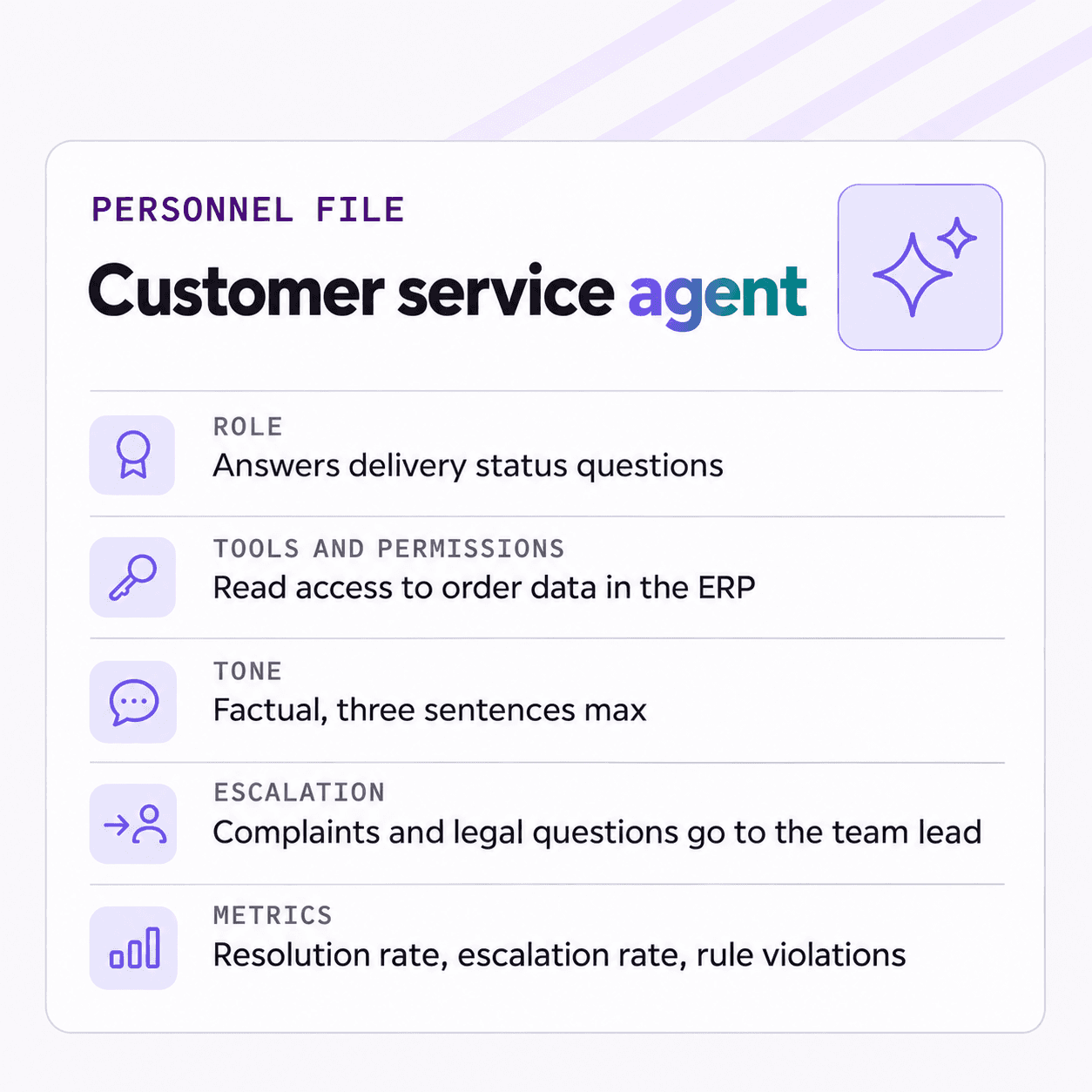
An AI agent's personnel file is its binding job description. It defines what the agent is responsible for, which tools and data it may use, how it communicates and when it hands off to a human. Technically, it lives in the system prompt, the base instructions given to the language model, and in the configuration of access rights.
 AI-generated
| Element | Key question | Customer service example |
|---|---|---|
| Role | What is the agent responsible for, and what not? | Answers delivery status questions, does not handle complaints |
| Tools and permissions | Which systems may it read or change? | Read access to order data in the ERP, no write access |
| Tone | How does it talk, and to whom? | Factual, three sentences max, no jargon |
| Limits and escalation | When does it hand off to a human? | Complaints, legal questions or unclear data |
| Metrics | How is it measured? | Resolution rate, escalation rate, rule violations |
The personnel file first builds acceptance. Employees know what the agent can do, where its job ends and who is responsible for it. An agent with a recognizable, consistent character also lowers the barrier for staff with little AI experience.
One caveat: the agent must not come across as too human. If it simulates empathy or personality too convincingly, users scrutinize its output less and lose sight of its limits. The personnel file should therefore state that the agent communicates in an approachable way but always identifies itself as a machine.
The second job is security. Agents access company systems through APIs and the Model Context Protocol (MCP), an open standard for connecting tools. If the personnel file ties every tool to the job description and a central AI gateway enforces those rules, each agent gets only the permissions it actually needs.
This principle of least privilege limits the damage when an agent misreads an instruction or is manipulated through hidden commands in documents.
Who manages the digital coworker?
The manager in the business unit, not the IT department. That manager defines the agent's role, supplies context, reviews early results and decides when the agent gets more leeway. Whether a team actually changes how it works, however, is decided in the line organization.
Data from Gallup shows how strongly managers shape adoption. Employees who strongly agree that their manager actively supports their team's use of AI are 2.1 times as likely to use AI a few times a week or more. Yet only 28 percent of employees in organizations that have begun implementing AI report that kind of support.
Onboarding an agent resembles onboarding a junior employee. Its first outputs get close review. When the manager corrects a mistake, the feedback is documented so it flows back into the agent's knowledge base. Only once the agent handles routine tasks reliably does it get more responsibility.
A pragmatic starting point often emerges in projects. The first agent relieves managers themselves, for example with status reports or tracking open items. People who see the time savings in their own work are more likely to become advocates.
Autonomy is something an agent has to earn
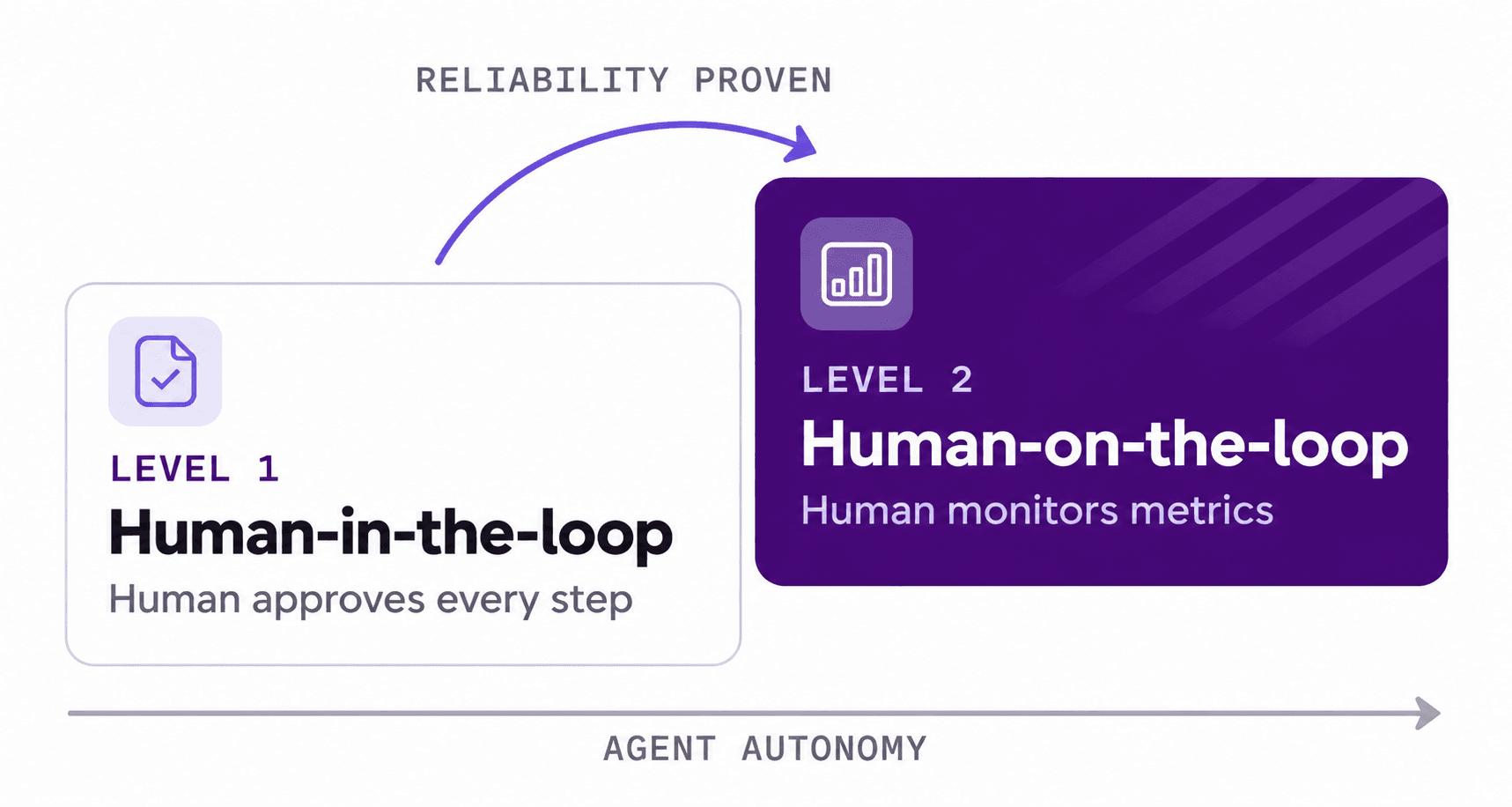
Autonomy is granted in stages. In human-in-the-loop mode, the agent proposes a step and a human reviews and approves it. In human-on-the-loop mode, the agent works independently while a human monitors metrics and steps in when something looks off. Moving between the two is a management decision based on performance data.
 AI-generated
At high volumes, human oversight alone is not enough. A common architecture pattern is the actor-critic approach: a second agent checks every planned action of the first against the rules in the personnel file before it is executed. If a proposal breaks a rule, the reviewing agent blocks it, explains why and requests a correction.
Three questions work well for regular performance reviews. Does the agent follow the rules in its personnel file? Does it stay in role across long conversations, or does its profile drift? Does it hit the intended tone?
Payment provider Klarna shows both how quickly an agent can make an impact and where its limits lie. In February 2024, the company said its AI assistant had handled 2.3 million conversations in its first month, two-thirds of all customer service chats. Customers now resolved their issues in under two minutes instead of eleven.
In May 2025, Klarna CEO Sebastian Siemiatkowski acknowledged in an interview that cost had been too dominant a factor in organizing customer service, and that the result was lower quality. Klarna then began recruiting its own human customer service agents again.
The takeaway: the agent handles routine work, while people handle exceptions, complaints and emotionally difficult cases. That escalation path belongs in the personnel file from day one.
What does the EU AI Act require of AI agents?
That depends on the use case. Agents used in HR, for example in candidate screening or performance evaluation, and in credit scoring count as high-risk systems under Annex III of the AI Act. The additional obligations for these systems apply from December 2, 2027. Transparency obligations already apply today, regardless of risk class.
The deadline was pushed back by the Digital Omnibus, an EU amendment package. It was published in the Official Journal on July 24, 2026, as Regulation (EU) 2026/1744. Originally, the Annex III high-risk obligations would have applied from August 2, 2026. For high-risk AI in products covered by EU product legislation under Annex I, the date is now August 2, 2028.
The obligations for high-risk systems largely match what a personnel file and a feedback loop should deliver anyway:
- Risk management (Article 9): identify and mitigate risks across the entire lifecycle.
- Data governance (Article 10): check and document the quality and provenance of training and test data.
- Documentation and record-keeping (Articles 11 and 12): describe how the system works and log events automatically.
- Human oversight (Article 14): people must be able to understand outputs, override them and stop the system.
- Robustness and cybersecurity (Article 15): the system must withstand manipulation attempts.
Most obligations fall on the provider, meaning whoever develops an AI system or has it developed, rather than the deployer who uses it. Anyone who substantially modifies a purchased high-risk system or markets it under their own name can become a provider under Article 25.
For customer service agents, Article 50 matters most. It has applied since August 2, 2026. AI systems that interact directly with people must be designed so those people know they are dealing with AI, unless that is obvious. EU AI Act consulting helps companies classify their own agents.
What companies should do now
- Pick a bottleneck, not a tool. Choose a process that measurably costs time or money and record its baseline up front.
- Redesign the workflow before the agent takes it over.
- Write the personnel file: role, tools based on least privilege, tone, escalation paths and metrics.
- Assign an accountable manager who reviews outputs and feeds corrections back into the knowledge base.
- Start in human-in-the-loop mode and define in advance which metrics allow the agent to work more independently.
- Build an AI inventory and classify every agent under the AI Act, starting with HR applications.
An AI workshop with the business units is a good way to identify which process suits a first agent. How that becomes a workable roadmap for mid-sized companies (Mittelstand) in Germany is covered on the page on AI consulting for mid-sized companies.
The bottom line: the bottleneck with AI agents rarely lies in the model. It lies in whether a company is willing to give a new coworker clear tasks, firm limits and a manager. Companies that settle this from the start can expand autonomy step by step instead of backpedaling after the first mistakes.
Frequently asked questions
What is a personnel file for AI agents?
A personnel file is the binding description of an AI agent. It defines the agent's role, its tools and access rights, its communication style and its escalation rules. Technically, it lives in the system prompt and the permission settings. It tells employees what the agent is allowed to do and who is responsible for it, and it prevents the agent from using systems outside its job.
When can an AI agent work without human approval?
Only once it has proven reliable on clearly defined, low-risk tasks. New agents should start in human-in-the-loop mode, where a person approves every step. If error and escalation rates stay stable over a longer period, the responsible manager can switch to oversight via metrics. For high-risk applications, the EU AI Act requires effective human oversight in any case.
When do the EU AI Act high-risk obligations apply?
For high-risk systems under Annex III of the AI Act, such as those used in HR or credit scoring, the obligations apply from December 2, 2027. The Digital Omnibus, Regulation (EU) 2026/1744, postponed the original date of August 2, 2026. For AI in products covered by Annex I, the date is August 2, 2028. Transparency obligations under Article 50 have applied since August 2026.
Why do so many AI projects fail?
Mostly for organizational reasons. Companies buy tools before analyzing the problem, skip measuring a baseline and put AI on top of unchanged processes. According to S&P Global, 42 percent of surveyed companies abandoned most of their AI initiatives in 2025. McKinsey finds that successful companies are nearly three times as likely as others to fundamentally redesign their workflows.
Deploying AI agents with clear roles and approval levels
In the workshop, we select the right process for your first AI agent and draft its personnel file, covering role, permissions, escalation rules and criteria for more autonomy.
Request a workshopSources
- The Formula for Agentic AI Value: The Applied AI Index 2026 – Boston Consulting Group, September 30, 2026
- ‘AI fatigue’ is settling in as companies’ proofs of concept increasingly fail. Here’s how to prevent it – Fortune (data: S&P Global Market Intelligence), June 11, 2025
- The state of AI in 2025: Agents, innovation, and transformation – McKinsey & Company, November 5, 2025
- Manager Support Drives Employee AI Adoption – Gallup
- Klarna says OpenAI's AI agent does the work of 700 support agents – The Decoder
- Klarna Grapples with AI-Led Customer Service, Pivots to an “Uber Type of Setup” – CX Today, May 12, 2025
- Regulation (EU) 2024/1689 laying down harmonised rules on artificial intelligence (Artificial Intelligence Act) – Official Journal of the European Union / EUR-Lex, July 12, 2024
- Regulation (EU) 2026/1744 (Digital Omnibus on AI) – Official Journal of the European Union / EUR-Lex, July 24, 2026